
Forum Replies Created
-
AuthorPosts
-
 MauriceToetParticipant
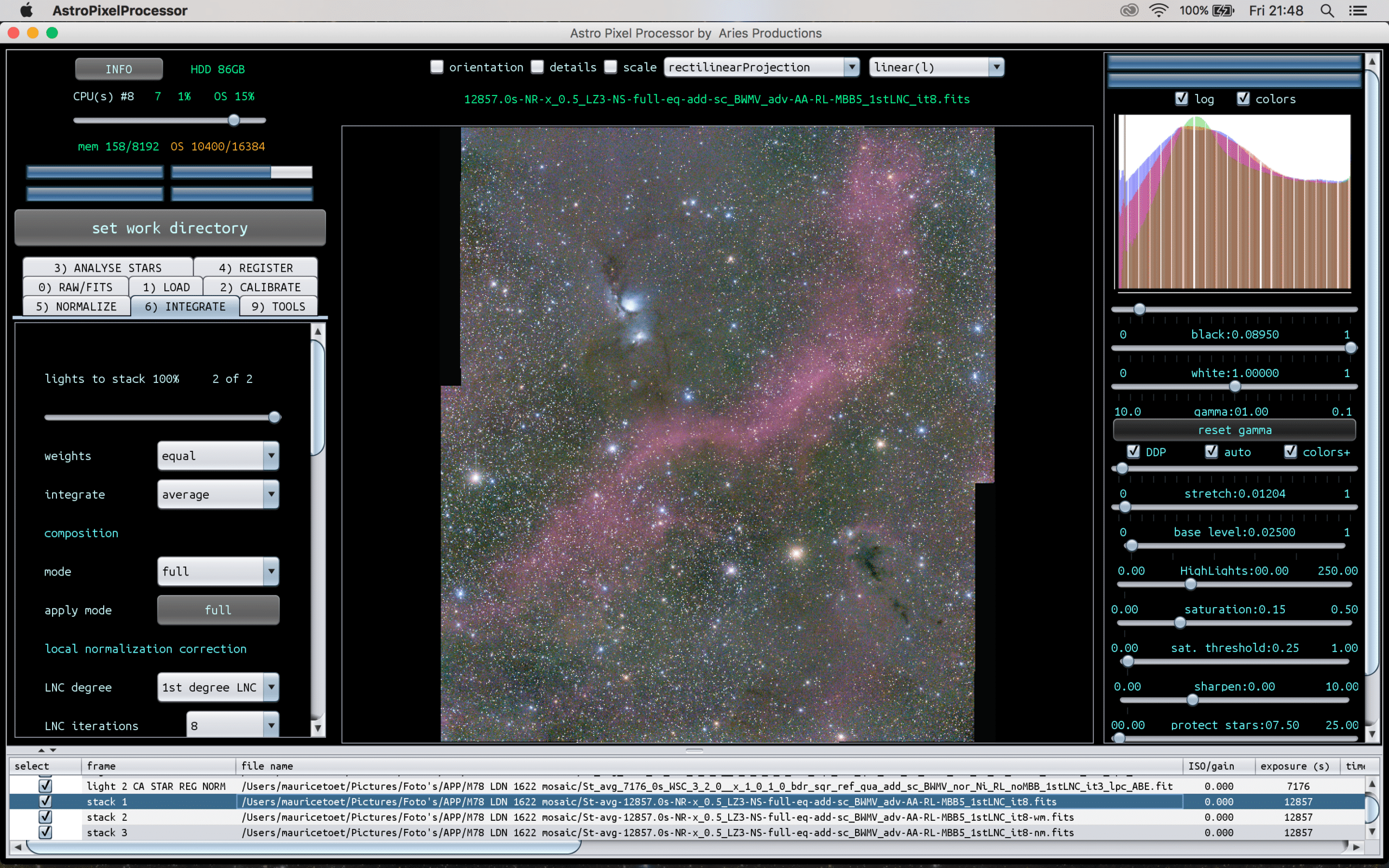
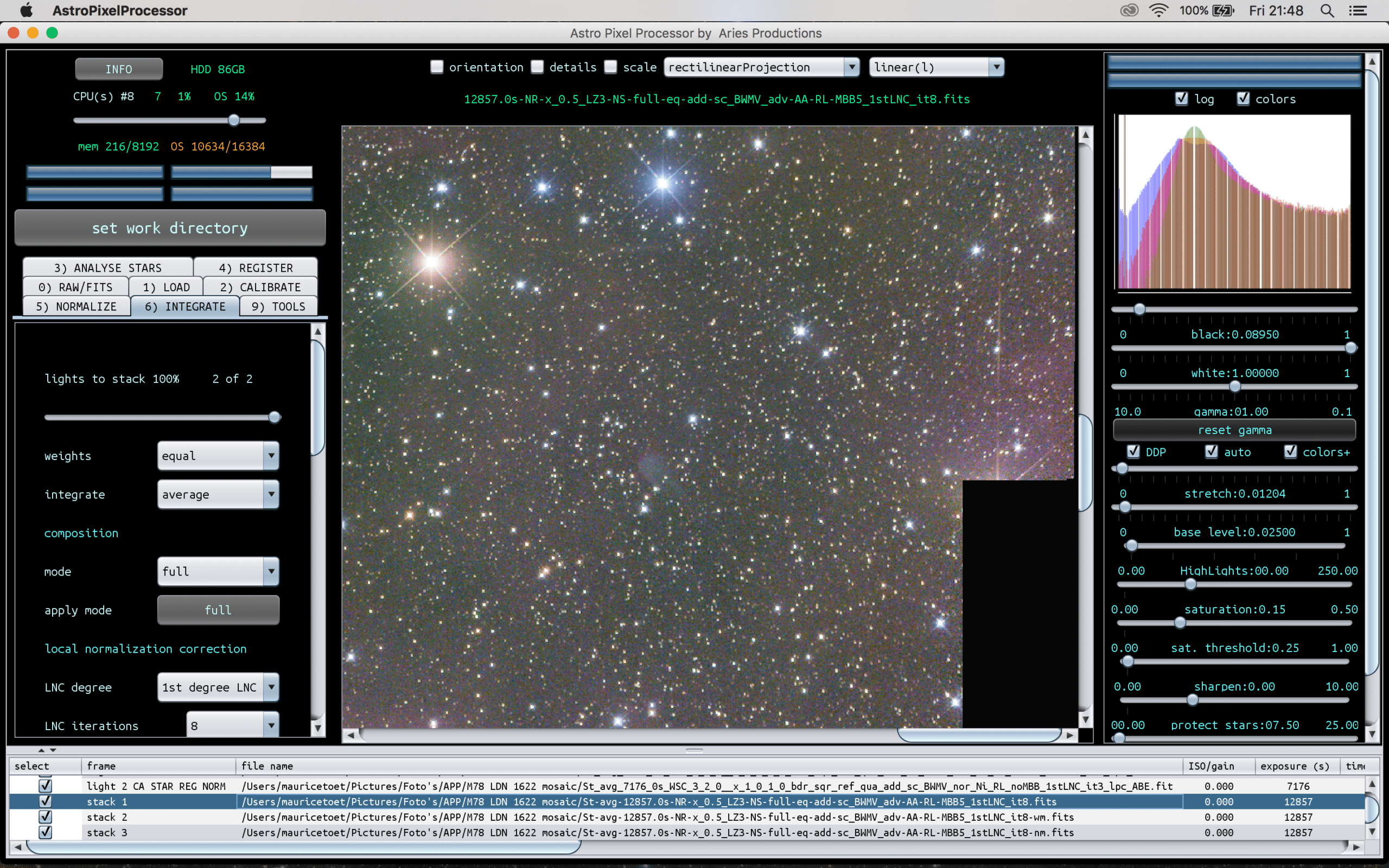
I’m experimenting to get a properly aligned (registered) mosaic in APP version 1.037. Still some minor flaws, though. Maybe they’re caused by edge of field distortions (coma, miscollimation).
@bula: what settings do you recommend under 4) register & 6) integrate?Technical details:
6 pane mosaic with Tak Epsilon-180ED, Atik 11000. Data acquired in August 2015. Total integration time of 11 hours, 15 minutes.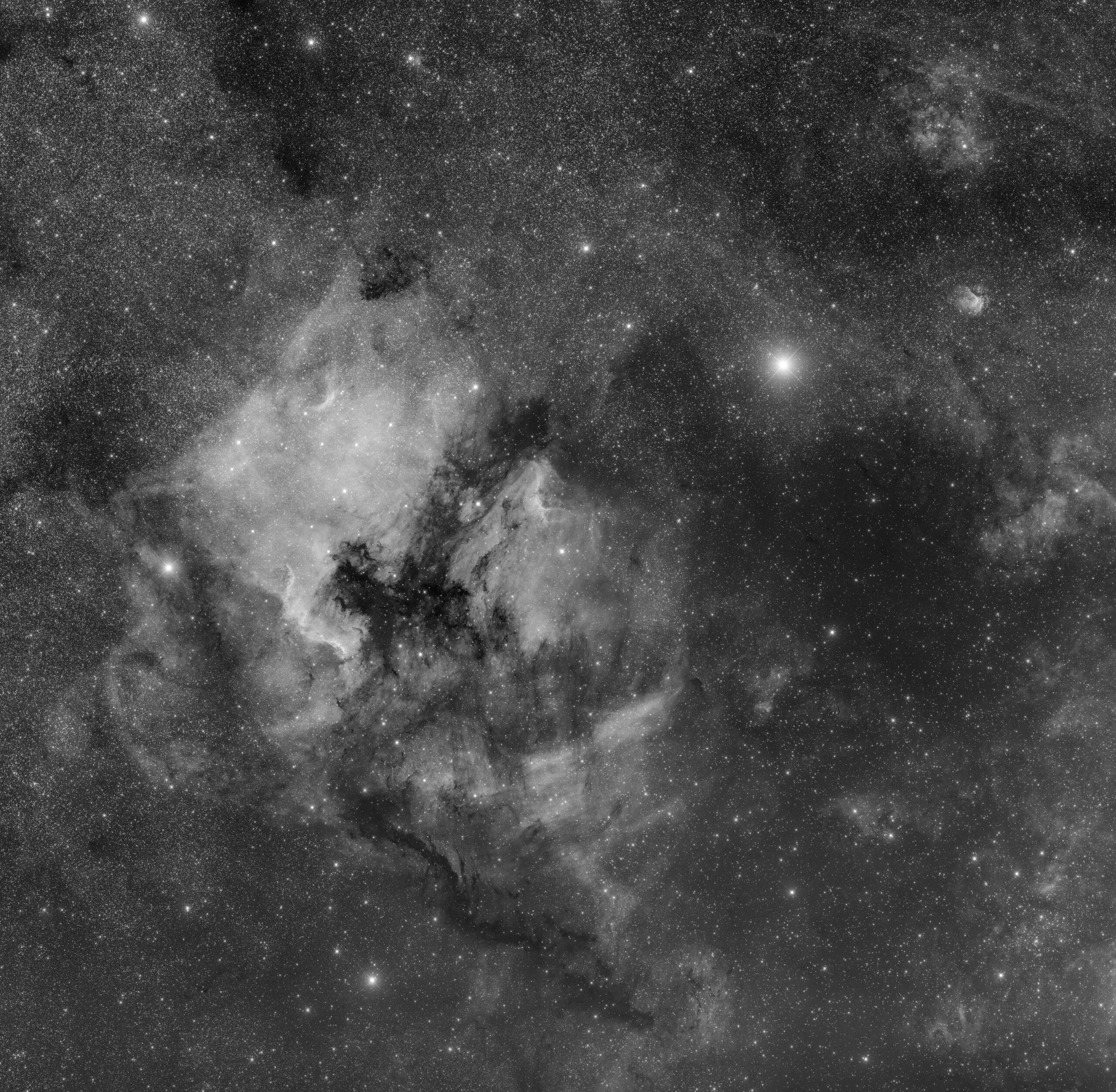 MauriceToetParticipant
Thank you, Mabula. As soon as time permits, I’ll continue working on the mosaic with the latest beta version of APP.
May 2, 2017 at 11:58 in reply to: Calibration frames with different ISO settings, how to process? #14765MauriceToetParticipantYou can either do:
[light – n * dark] / [m * (flat – masterbias)]
or
[(light – masterbias) – n * (dark – masterbias)] / [m * (flat – masterbias)]
where:
n * dark = a masterdark with the bias offset
n * (dark – masterbias) = a masterdark without the bias offsetMauriceToetParticipantI was just typing my previous message when you replied. So yes, I can confirm it happens after enabling dynamic distortion correction. I’ll send you the data set so you can test it.
MauriceToetParticipantThis sphere issue occurs after enabling “use dynamic distortion correction”. I’ll check what happens with the next set of data (3rd panel of the mosaic).
May 1, 2017 at 18:16 in reply to: Calibration frames with different ISO settings, how to process? #14724MauriceToetParticipantin my first reaction to @mauricetoet‘s question in this post I explained everything I think. As everyone could see, Maurice was able to perfectly calibrate his f/2.8 DSLR data with flat & light frames which had different iso values
Your explanation was perfectly clear to me, so I don’t know why others are struggling. Before actually stacking the data, you can get instant feedback from APP to check if the calibration files were probably prepared. I cannot imagine a clearer warning signal.
BTW. If you use darks, I won’t bother using a masterbias to correct the lights and darks (as the bias offset is both in the lights and darks). To keep things simple and clear, just bias-correct the flats.
MauriceToetParticipant@bula, @musquetier, @keesscherer en @supernov: bedankt voor jullie complimenten. Mede mogelijk gemaakt door APP ;-)
MauriceToetParticipantAnd here’s the post-processed (in Photoshop CC) result.
1h35 minutes of exposure time for the M78 pane, 2h of exposure time for the LDN 1622 pane. Exposed with a Baader modded Canon 5D MKIII @ ISO 1600 (5 min. subs) and Takahashi Epsilon-180ED. 25 February 2017, Étoile-Saint-Cyrice (France).
 MauriceToetParticipant
Hoi Maurice, klik eens op het blauwe camera symbooltje voor de aardigheid rechtsonder het invoerveld i.p.v Attachments (No Photos) bij het uploaden van images.
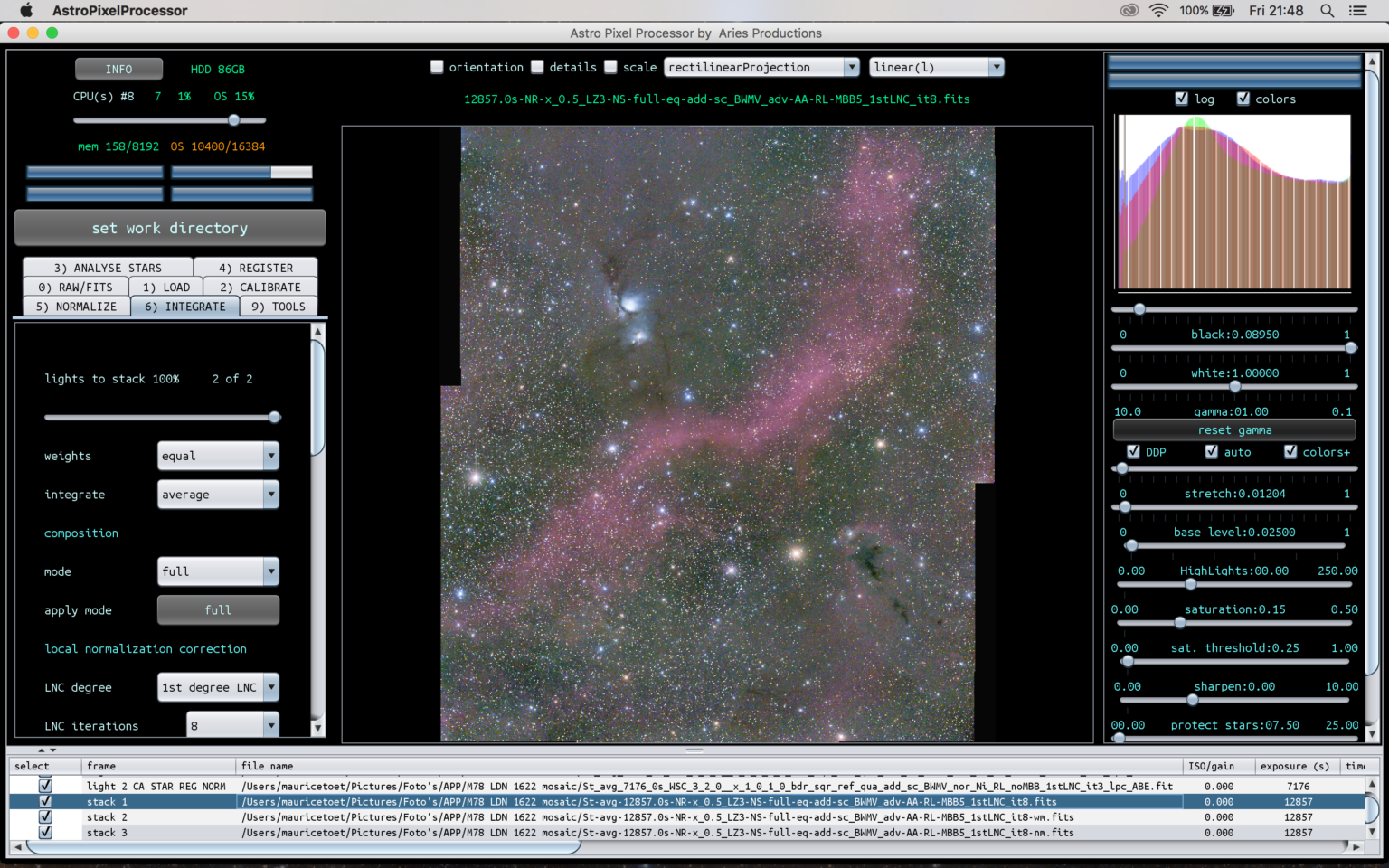
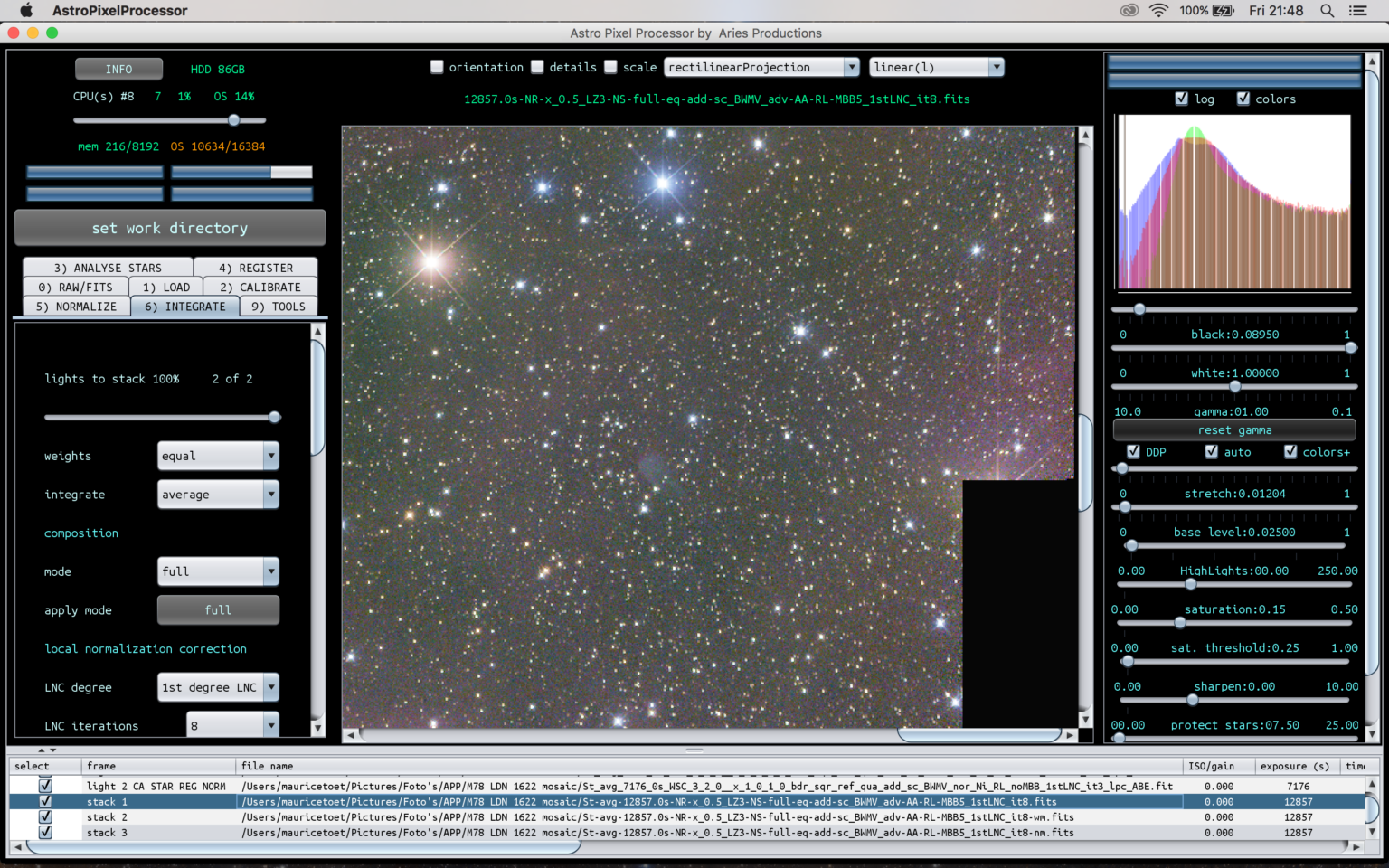
Aha, dat ziet er beter uit ;-) Al die keren over “No Photos” heen gelezen… Doorgaans upload ik foto’s op mijn eigen website waarnaar ik vervolgens hotlink.MauriceToetParticipantThank you very much, Mabula. This worked excellent! (See attachments.)
Request for change: I think most users would appreciate if you set the “number of lights to stack” at 100% by default. In this particular case, I had two panels to align, and the program only selected one by default.
 March 24, 2017 at 19:57 in reply to: Calibration frames with different ISO settings, how to process? #13279MauriceToetParticipant
Yes, @bula, everything worked out fine. Next question is… how to create a seamless mosaic? ? That’s something to discuss in a new topic.
 March 23, 2017 at 19:51 in reply to: Calibration frames with different ISO settings, how to process? #13214MauriceToetParticipant
Thanks for the further clarification and your proposal to convert the PI calibration files to APP files. I’ve just shot new sets op bias frames and APP is “chewing” on it as we speak ;-)
March 23, 2017 at 18:07 in reply to: Calibration frames with different ISO settings, how to process? #13212MauriceToetParticipantExcellent, Mabula. Very clever! I’ll have to make new (master) bias frames; which is not a problem. It didn’t work with converted PixInsight xisf to fits master bias files (probably due to missing gain info in the header).
MauriceToetParticipantBedankt voor jullie lovende woorden!
MauriceToetParticipantMaar de read noise vlakt wel af, waardoor je wel een lineair gebied krijgt van de afname van je dynamic range bij ISO op een log scale (zoals je kunt zien in je grafiek) het begin van dit lineaire gebruik is een goede keus voor de ‘beste ISO’ aangezien daarboven geen/nauwelijks nog winst behaald wordt.
Dat is eigenlijk wat ik probeerde aan te geven ;-) Zodra de curve van de uitleesruis van verticaal afbuigt naar horizontaal, valt er geen winst meer te behalen.
Pas aub op met dit soort absolute uitspraken Dit verschilt alsnog per model en er zijn Nikons die je op 400 of 800 wilt gebruiken.
Terecht opgemerkt!
-
AuthorPosts